
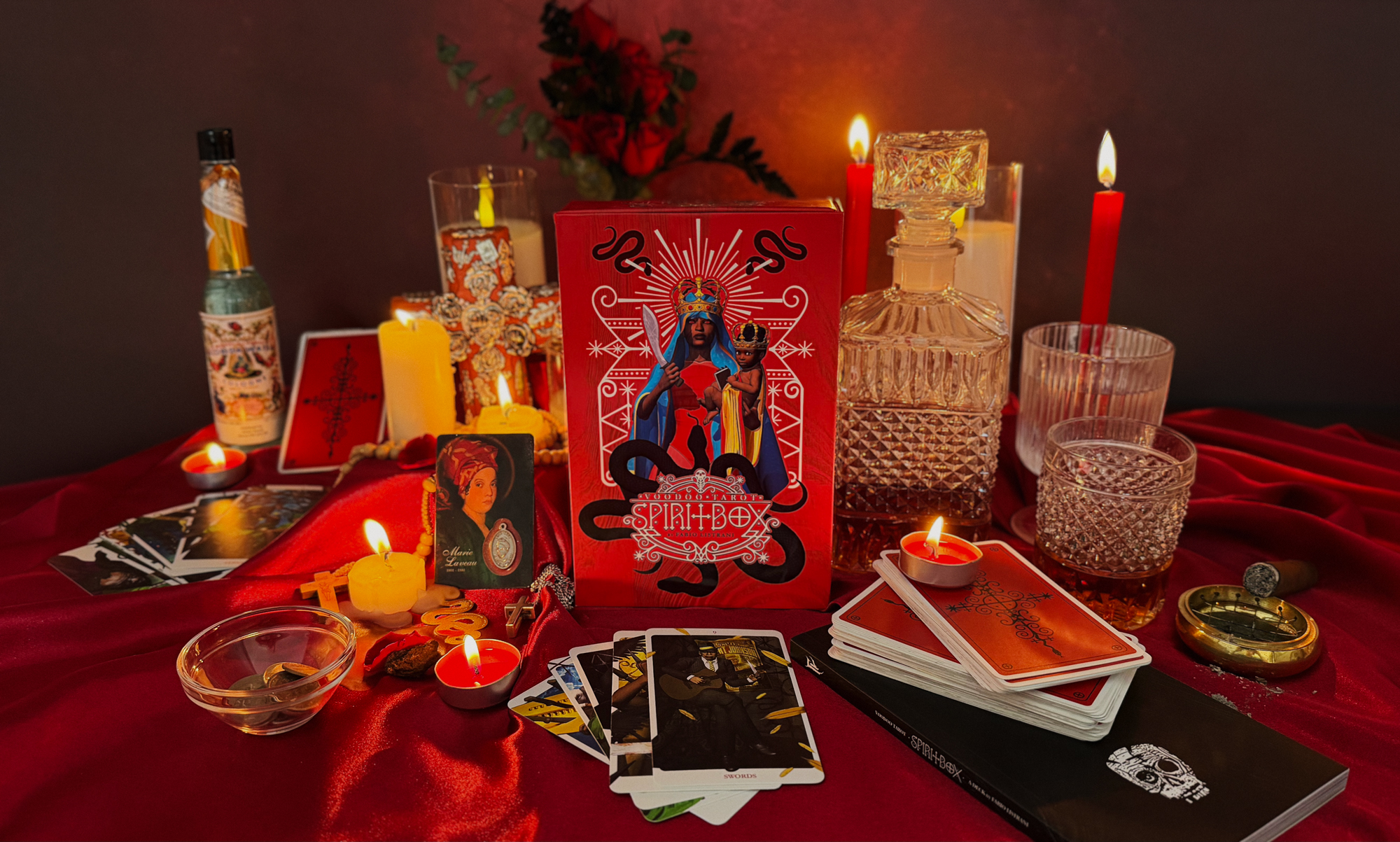
DECK OF THE MONTH: The Voodoo Tarot Kit: Spirit Box
78-card tarot deck that explores Haitian Vodou through symbolism, ancestry, and spiritual structure.
The Voodoo Tarot: Spirit Box, created by Fabio Listrani, feels suited to those who are drawn to working with tarot in a more intentional way.
Each card is connected to a Lwa, bringing an added layer to the reading and a stronger sense of presence within the deck.
Whilst the deck follows the structure of the traditional Rider-Waite system, it invites you to approach the cards differently, with more awareness of spirit, ancestry, and meaning.
First impressions and overall feel
The Voodoo Tarot Kit: Spirit Box, created by Fabio Listrani, features a striking image of Erzulie Dantor on the cover, a Lwa associated with protection, motherhood, and fierce love, shown holding a knife and a crowned child. Instantly, this deck feels powerful. Upon opening the box, I loved that it has a side magnet switch that feels as though you’re opening a book. I didn’t realise that this would later make sense, as the deck itself carries a sense of education beyond insight and intuition.
Upon initially looking at the art, the deck feels totally different from the Rider-Waite, despite following the same pattern of the Major and Minor Arcana. This deck feels intentional and strategic in the way it places culture and ancestry at the forefront. It has a nice feel when shuffling due to the matte, satin-like texture on medium stock card.

What the deck
seems suited for
(Based on imagery and structure)
This deck has some nudity within the art, so bear this in mind according to your taste and comfort. The Voodoo Tarot: Spirit Box is best suited for individuals with an active connection to, or interest in, Vodou and ancestral connection. Whilst the deck may be used by all, there’s a degree of seriousness that this deck carries, alongside an awareness of how to honour and revere culture without appropriating it.
Vodou itself is a spiritual tradition rooted in Haiti, shaped through the blending of West African belief systems with elements of Catholicism during the transatlantic slave trade. It is a living practice centred around ancestry, community, and relationship with the Lwa, who act as intermediaries between the human and spiritual worlds. Ritual, offering, and respect sit at the core of this practice, which is why intention feels especially important when working with a deck such as this.
I would personally suggest this deck is used within an existing ritual-based practice, as when I connected to the cards, there was an element of slowness that carries truth. Ritual is also an integral practice within Vodou tradition.
This deck needs to be taken seriously, as it isn’t one for providing light and tender messages. It unearths messages in a much more direct and cut-throat way.
The Voodoo Tarot: Spirit Box can also be used for self-practice and connection, as well as professionally, but with those who have ancestral ties to Vodou heritage. Due to the symbolic nature of this deck, I would suggest it is used for honouring passages such as initiations, ego work, and acceptance.
Personal reflections or preferences
The Voodoo Tarot: Spirit Box is not a deck to be played with. If you want humbling honesty and redirection, this deck feels like it will provide exactly that.
The first thing I noticed is that each of the Major Arcana relates to a member of the Lwa. Each card represents a divine figure who serves as a bridge between the creator and us. This in itself felt powerful enough for me to pause, as each Lwa carries their own role, ritual, and energy alongside the traditional Rider-Waite interpretation.
I then noticed the court cards all have different names, which link to the Lwa. If you are not familiar with this concept, this feels like a good place to start. With this in mind, I think it is important, when working with this deck, to try to avoid comparison to the Rider-Waite deck, as the energetic difference provides new meaning.
The court cards are broken down into:
• Dolls (Page) – Messengers to the spirit world
• Mambo (Queen) – Priestess/healer who performs rituals after deep initiation, holding power through spirit
• Ougan (King) – Priest and leader of the community, serving the Lwa
• Horse (Knight) – A chosen spirit who acts and speaks in the physical world
Cards that stand out and why
The back of the deck is black and red, and features the symbol of Marassa Jumeaux, the sacred twins within Haitian Vodou, which can also be seen with The Lovers. That itself carries the meaning of connecting you to your inner strength, passion and fire, whilst also protecting you and providing truth from the underworld with love.
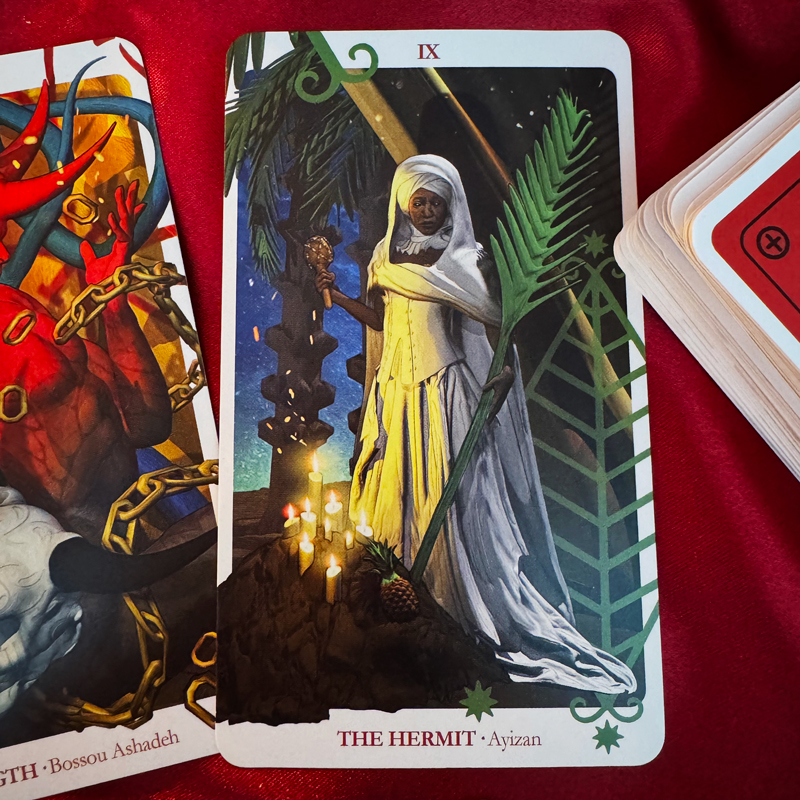
Hermit (Ayizan)
Ayizan, a Lwa associated with initiation, sacred knowledge, and spiritual authority, shows another side to the Hermit, where she stands in her wisdom and inner knowing.
The Hermit seeks to retreat for insight, but in this deck, it feels like a simple reconnection to one’s own truth. The card feels like wisdom accessed through quiet ritual. In the traditional deck, the figure holds a lantern and is slightly hunched, which feels uncertain. Ayizan stands strong in her self-awareness.
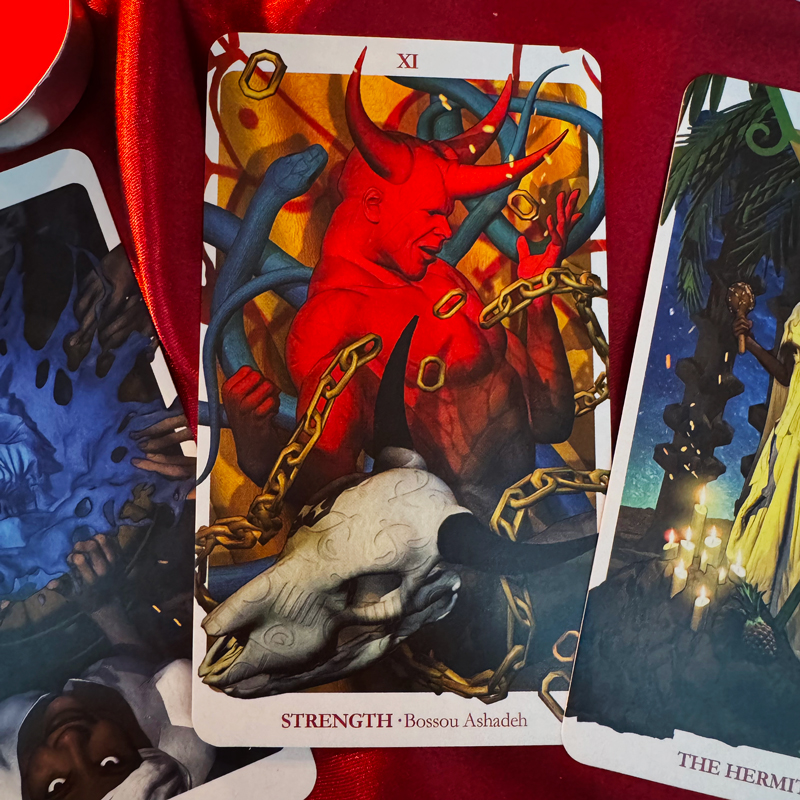
Bossou Ashadeh, a Lwa often associated with strength, resilience, and raw, untamed power, carries a striking image of breaking chains or shackles, representing what may be holding one back from their true power and path.
Strength feels like autonomy and power in this deck, acknowledging one’s own capability to transcend. In the traditional deck, Strength feels more tame and gentle, whereas Bossou Ashadeh represents fierceness.
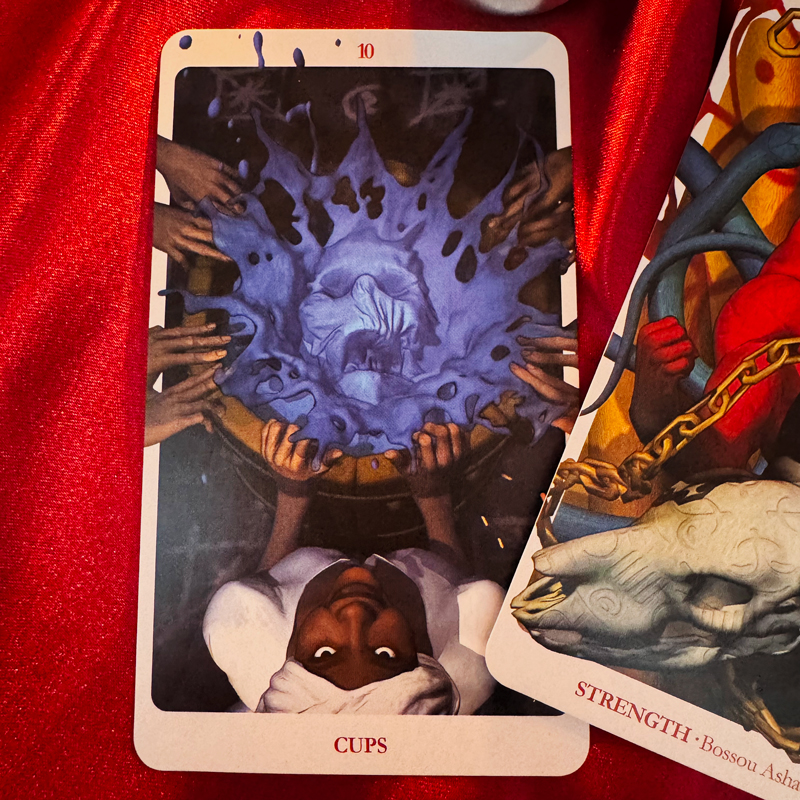
10 of Cups
There is a figure in white looking upward, almost in acceptance, surrounded by multiple hands around a well of water, revealing some sort of truth. This feels like the continuation of ancestral legacy. The card carries a deeper meaning of crossing a threshold into initiation of what is rightfully yours.
Traditionally, this card is depicted with a rainbow, giving a sense of renewal, whereas in this deck, there is an acknowledgement that responsibility is associated with fulfilment.
Additional features
The Voodoo Tarot: Spirit Box comes with a detailed guidebook that offers in-depth explanations of each card, including the symbolism, stories, and spiritual context behind the Lwa.
The deck follows the traditional tarot structure, but the guidebook allows you to move beyond standard meanings, bridging tarot with Vodou practice and providing insight into ancestry, ritual, and spiritual systems.
This feels less like a deck for quick reference, and more like something you return to and build a relationship with over time.
About the Creator
The Voodoo Tarot: Spirit Box was created by Fabio Listrani, a self-taught artist and illustrator based in Rome, whose work spans across tarot, publishing, music, and visual storytelling. He has worked with major international names including Marvel, Titan Comics, and IDW Publishing, bringing a strong visual identity to projects such as X-Men, Warhammer 40,000, and Dark Souls.
Within tarot, he is known for decks such as Night Sun Tarot and Santa Muerte Tarot, both of which carry a distinct visual language and depth of symbolism. His work tends to feel immersive, often drawing you into a fully realised world rather than simply presenting imagery.
With Voodoo Tarot: Spirit Box, there is a clear shift into something more research-led and intentional. The deck is rooted in Haitian Vodou, with each card reflecting elements of the tradition, including the Lwa and their roles as intermediaries between the physical and spiritual worlds.
The artwork feels considered rather than decorative. There’s an awareness throughout the deck that this is not just aesthetic inspiration, but something that has been studied and approached with care.
Alongside the deck, the guidebook offers further context, bridging traditional tarot structure with Vodou symbolism, allowing the reader to move between both systems with more understanding.
The Voodoo Tarot: Spirit Box is available to purchase, while stocks last, in-store and online at Wax Spiritual for £37.99.
Wax Spiritual
More Blog Posts

Deck of the Month: Inner Child Oracle
Deck of the Month: Inner Child Oracle explores Amanda Lynn Aisling’s nurturing oracle deck through Mimi’s perspective. From reflective prompts and vibrant artwork to the gentle practices within the accompanying guidebook, discover what makes this deck a thoughtful companion for inner child work and personal growth.

DECK OF THE MONTH: Tarot Divinatorium
Deck of the Month: Tarot Divinatorium explores André Sanchez’s richly layered Rider–Waite–Smith-inspired deck through Mimi’s perspective. From mirrored symbolism and baroque-inspired artwork to the experience of reading with the cards, discover what makes this visually striking deck stand out.

From Transformation to Guidance: An Interview with Antoinette
What first draws someone to tarot, and what turns that interest into a path of helping others? In this interview, Antoinette shares her journey into spiritual work, her philosophy on healing and transformation, and the approach that guides her readings today.
