
Christianity & Spiritual Practice: They Were Never Separate
There’s a common misconception that Christianity and spiritual practice sit separately from each other.
That prayer belongs to one path, while candle work, ritual, rootwork, or spirit-led practice belongs to another. In reality, these systems have existed alongside each other for a very long time, particularly within African-descended traditions where spiritual practices adapted and continued under changing conditions.
In many cases, elements of Christianity became intertwined with spiritual practice through survival, restriction, and lived experience. Saints, scripture, prayer, and church imagery provided an outward framework that could often be practised openly, while deeper spiritual systems continued underneath and alongside it.
Because of this, we see traditions where Christianity and spiritual practice do not function as opposites, but as part of the same lived structure.
Practices such as Hoodoo, Haitian Vodou, Santería/Lukumí, Obeah, Spiritual Baptist traditions, Revivalist traditions, New Orleans Voodoo, and other African-descended spiritual systems are all distinct practices with their own histories, structures, and cultural contexts.
Some developed strong visible connections with Catholicism through the use of saints, devotional imagery, and formal syncretism. Others incorporated Protestant Christianity more heavily through prayer, Biblical scripture, Psalms, prophecy, and spirit-led worship.
While these systems are not interchangeable, many contain visible overlaps involving prayer, candles, spiritual cleansing, petitions, offerings, ancestor reverence, and spirit-led work. In many cases, Christianity became woven into how the practices survived, adapted, and continued across generations.
Prayer is often central to the work. Psalms may be used as direct petitions. Saints may be approached as intercessors for protection, healing, justice, communication, or urgency.
This can also be seen within traditions such as 21 Divisions, Spiritual Baptist traditions, and certain White Garment Church settings, where scripture, prophecy, cleansing, prayer, and spiritual work exist side by side. In these spaces, there often isn’t a strict divide between what is considered “Christian” and what is considered “spiritual” practice. The two operate together as part of a lived system.
In Practice
Prayer, Psalms, candles, petitions, spiritual baths, offerings, oils, incense, and devotional work often appear together because they form part of an established spiritual structure, not separate systems being randomly combined.
Common examples include:
- Psalms used as direct petitions for protection, justice, clarity, uncrossing, or healing
- Candles burned alongside prayer to hold focus and intention
- Saints approached for specific needs such as urgent help, protection, communication, or strength
- Petition papers placed beneath candles, combining written intention with prayer
- Spiritual cleansing carried out alongside scripture, prayer, or devotional offerings
These are not modern additions or aesthetic adaptations. They reflect practices that have been maintained, adapted, and passed down over generations.
Saints, Spirits & Syncretic Traditions
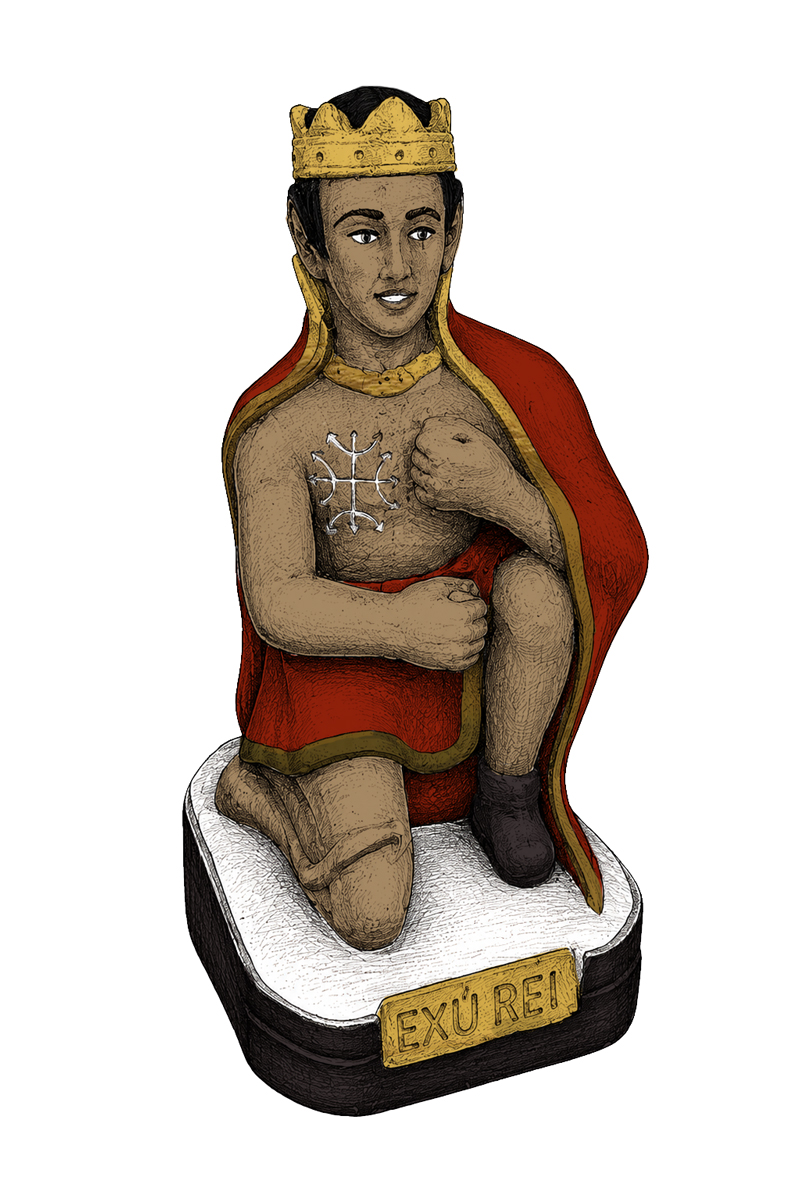
Across African-descended spiritual systems such as Haitian Vodou, Santería/Lukumí, and related traditions, Catholic saints have at times been used as outward representations of spirits, Lwa, or orishas.
These associations developed through shared symbolism, imagery, roles, and spiritual function. They are not fixed or universal and can vary by lineage, region, and practice.
Some commonly recognised examples include:
- Saint Peter associated with Papa Legba or Elegua, connected to gates, crossroads, access, and communication
- Saint Patrick associated with Damballah Wedo, connected through symbolism involving snakes, wisdom, and spiritual authority
- Saint Barbara associated with Changó, connected to lightning, fire, strength, and warrior energy
- Our Lady of Charity associated with Oshun and, in some traditions, Erzulie Freda, connected to love, beauty, prosperity, and sweetness
- Marian figures such as the Black Madonna or Our Lady of Prompt Succor associated in some traditions with Erzulie Dantor, connected to protection, motherhood, endurance, and defence
- Saint Lazarus associated with Babalú-Ayé, connected to illness, healing, suffering, and recovery
- Saint Expedite associated in some traditions with figures such as Baron Lakwa (Baron Lacroix), connected to urgent causes, quick solutions, business and legal matters, financial success, and overcoming obstacles requiring immediate action
They are not universal or interchangeable, and vary across lineages, houses, regions, and traditions. Many practitioners maintain a clear distinction between saints and spirits, even where connections are recognised.
Depending on the tradition, devotional relationships may involve prayer, offerings, candles, feast days, songs, altars, petitions, and specific ritual structures.
Reducing these relationships to simplified “matches” removes much of the historical depth and spiritual structure behind them.
A Note on Different Systems
It’s also important to recognise that similar tools do not automatically mean the practices themselves are the same.
Candles, prayer, cleansing rituals, Psalms, offerings, spirit communication, or devotional work may appear across many traditions, but the structure, meaning, and purpose behind those practices can differ significantly.
For example, Haitian Vodou and Santería/Lukumí are structured religious systems involving initiation, ceremony, lineage, sacred protocol, and established relationships with specific spirits and divinities.
Practices such as Hoodoo or rootwork are generally understood differently, often functioning more as systems of folk spirituality, practical workings, ancestral tradition, or community-based spiritual practice rather than formal religions.
Other traditions, including Spiritual Baptist, Revivalist, and certain White Garment church traditions, may exist somewhere between church structure, prophetic practice, spirit-led worship, and African diasporic spiritual continuity.
Obeah itself is also complex and historically difficult to define clearly, partly because the term was shaped through colonial criminalisation and used broadly across different Caribbean contexts. What one community calls Obeah may differ greatly from another.
The tools may overlap on the surface, but the structure behind the work, the cultural context, and the understanding of spirit, ancestry, ritual, and authority are what define the tradition.
Diaspora Practice & Quiet Continuities
These overlaps are not only historical or geographically distant. Variations of these blended practices continue across diaspora communities today, including within the UK.
In many African and Caribbean households, spiritual practice has often existed quietly alongside Christianity, sometimes openly, sometimes privately, and sometimes without being formally named at all.
This can include the use of Psalms for protection, prayer alongside cleansing rituals, candles burned with focused intention, spiritual baths, devotional images, offerings, prophetic work, or inherited family practices passed down informally through elders and community.
In some spaces, these practices exist within church environments themselves. In others, they remain private, spoken about selectively, or separated from public religious identity altogether.
This is particularly relevant when discussing traditions influenced by African and Caribbean spiritual systems, including practices connected to Obeah, Spiritual Baptist traditions, Revivalist traditions, White Garment churches, and other forms of diasporic folk spirituality.
Because of historical stigma, criminalisation, and misunderstanding, many of these practices were intentionally kept quiet. Some still are.
As a result, many people grow up around blended spiritual systems without always having language for what they are seeing.
Christianity and spiritual practice are often treated as separate categories publicly, while in lived experience, the boundaries may be far less clear.
Where People Often Begin
For many people, especially those raised within Christianity, spiritual practice does not begin by abandoning their faith or suddenly adopting an entirely different belief system.
Often, it begins with things that are already familiar:
- Prayer
- Psalms
- Lighting a candle with intention
- Spiritual cleansing
- Reflection and devotional practice
- Ancestor remembrance
- Creating space for focus, healing, protection, or clarity
For some, these practices remain fully connected to their Christian faith. For others, they become part of a broader spiritual exploration over time.
There is no single starting point, and not every person engaging with candles, prayer, cleansing, or spiritual tools is attempting to enter a formal religious tradition.
In many cases, people are simply reconnecting with intentional forms of spiritual practice that already existed quietly within their families, communities, churches, or cultural backgrounds.
Understanding the history behind these practices can help remove some of the fear and confusion people often carry around spirituality, particularly when they have been taught that Christianity and spiritual practice must exist in opposition to one another.
Bringing It Back
At its core, this misconception comes from trying to separate Christianity from spiritual practice entirely.
In reality, for many traditions, Christianity has long existed within the work itself. Not always as contradiction, and not always as replacement, but as part of how spiritual practice survived, adapted, and continued.
For some, this reflects genuine spiritual devotion. For others, it reflects adaptation and survival. In many cases, it reflects both.
Prayer, Psalms, saints, candles, petitions, offerings, and spirit work are not always separate systems being blended together.
In many traditions, they were never fully separate to begin with.
The more closely you look, the clearer that becomes.
Wax Spiritual
More Blog Posts

Deck of the Month: Inner Child Oracle
Deck of the Month: Inner Child Oracle explores Amanda Lynn Aisling’s nurturing oracle deck through Mimi’s perspective. From reflective prompts and vibrant artwork to the gentle practices within the accompanying guidebook, discover what makes this deck a thoughtful companion for inner child work and personal growth.

DECK OF THE MONTH: Tarot Divinatorium
Deck of the Month: Tarot Divinatorium explores André Sanchez’s richly layered Rider–Waite–Smith-inspired deck through Mimi’s perspective. From mirrored symbolism and baroque-inspired artwork to the experience of reading with the cards, discover what makes this visually striking deck stand out.

From Transformation to Guidance: An Interview with Antoinette
What first draws someone to tarot, and what turns that interest into a path of helping others? In this interview, Antoinette shares her journey into spiritual work, her philosophy on healing and transformation, and the approach that guides her readings today.
