
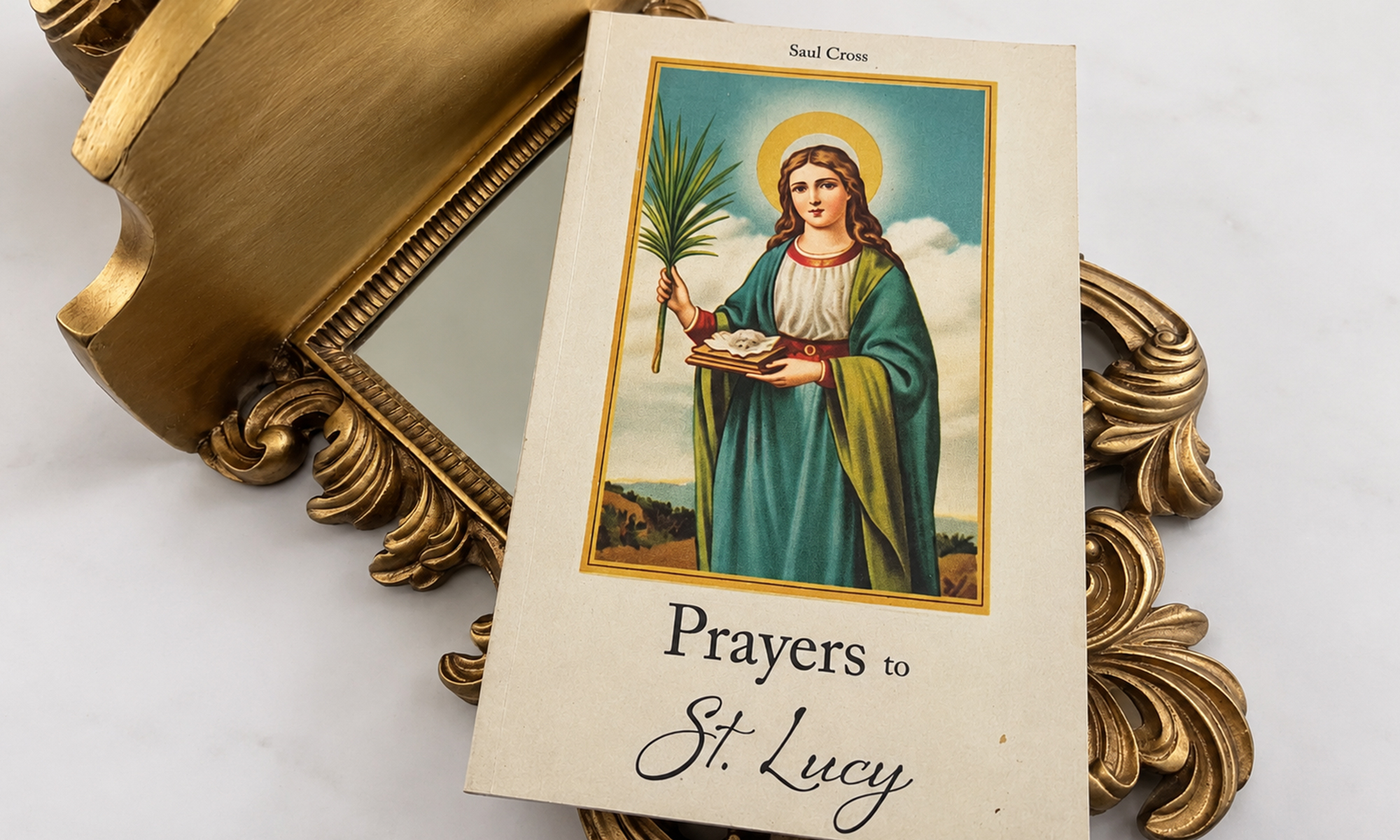
Saint Lucy: The Saint Who Kept Appearing
After Saint Lucy’s name began appearing in unexpected places, I became curious about the saint behind the signs. From sight and healing to folk magic and the Wild Hunt, her story also reveals how closely Christianity and spiritual practice have long intertwined.
A few days ago, I came across a post by spiritual counsellor, cardslinger and author Kelly-Ann Maddox in which she mentioned working with the Holy Mother Mary. Most of the response was curious and respectful, but there was also some criticism around witches working with what was described as “Christian stuff”.
What surprised me wasn’t that somebody might question it, but that we still tend to treat Christianity and witchcraft as though they have always existed on completely opposite sides of a line.
They haven’t.
I’ve written about this previously in Christianity & Spiritual Practice: They Were Never Separate, looking at the ways prayer, Psalms, saints, candles, cleansing, petitions and spirit-led practice have existed alongside each other across different traditions. The structure and meaning behind those practices can vary enormously, but Christianity has long formed part of many spiritual systems, particularly within folk traditions and diasporic practices.
Witchcraft itself is no more one single practice than Christianity is one single expression of faith. There are different traditions, branches, inherited practices, cultural practices and completely personal ones. There is no single set of beliefs that every witch follows, and someone else’s spiritual practice doesn’t require our approval simply because it looks different from our own.
That conversation stayed with me, partly because Antoinette had recently written about her own connection with Archangel Michael. In her piece, she mentions recognising his presence through repeated signs: hearing his name, noticing swords or repeatedly seeing the colour blue.
I understood exactly what she meant.
For me, one of those names was Saint Lucy.
When Saint Lucy Kept Appearing
I’d been drawn to Saint Lucy for a while before I really knew very much about her. Her name kept appearing. I started noticing artwork depicting her and references to her in places where I wasn’t necessarily looking for them.
Then I watched The Nun II and, unexpectedly, there she was again.
Obviously, I wouldn’t recommend a horror film as a reliable source of religious history. The film reimagines Saint Lucy for its own fictional mythology, but that wasn’t really what interested me. I hadn’t watched the film because she was in it. I didn’t even know she was going to appear.
She simply did.
And by that point, I was paying attention.
I experience this fairly often with deities, saints, spirits and other spiritual figures, but I don’t automatically interpret every repeated sign as the beginning of a permanent relationship.
Sometimes it feels more like an acknowledgement: I see what you’re doing.
Sometimes it’s closer to: You’re going through something. I’m here if you need me.
And sometimes certain figures seem to dip in and out over time, appearing when something about their symbolism, energy or story feels particularly relevant. Almost like an old friend checking in.
Not every spiritual connection needs to become a permanent fixture. Some simply return when needed.
Who Is Saint Lucy?
Saint Lucy, also known as Saint Lucia of Syracuse, was an early Christian martyr whose feast day is celebrated on 13 December.
As with many early saints, history and later legend have become intertwined around her story. She is traditionally described as a young Christian woman from Syracuse in Sicily who dedicated herself to her faith and was killed during the persecution of Christians in the early fourth century.
The most recognisable part of her iconography, however, is probably her eyes.
Saint Lucy is often depicted as a young woman holding a plate or dish containing a pair of eyes. In some images she still has eyes in her head; in others she may be shown without them. Other depictions show her praying before the tomb of Saint Agatha or with a blade representing her martyrdom.
Over time, she became strongly associated with sight, blindness and conditions affecting the eyes. Her name is also associated with the Latin lux, meaning light.
Sight. Light. Seeing.
That was where she became particularly interesting to me.
Because one thing I understand very clearly within my own spiritual practice is that you don’t necessarily need your physical eyes in order to see.
That’s me.
Suddenly, Saint Lucy appearing everywhere felt slightly less random.
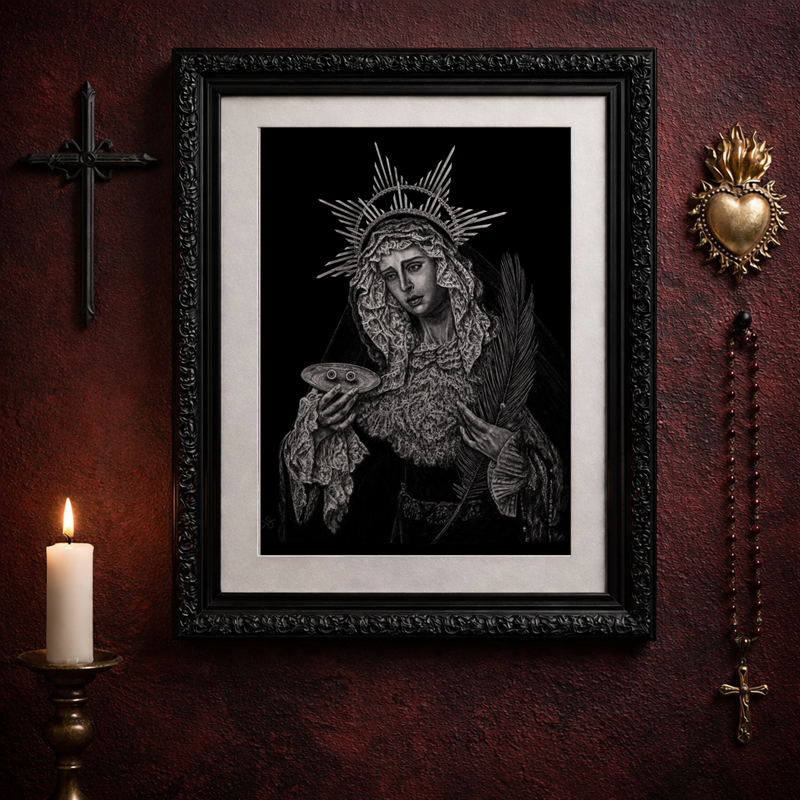
Saint Lucy in Folk Magic
Saints do not only exist within formal church settings.
They also exist within homes, family traditions, shrines, folk practices, healing traditions and devotional work. Their stories, symbols and associations can develop beyond official theology as people build relationships with them through culture, geography, inherited traditions and personal spiritual practice.
Saint Lucy is traditionally approached in matters concerning eyesight and physical healing, but within folk and magical practice those associations extend further.
Eyes do not only represent physical sight. They can represent awareness, perception, discernment and our ability to recognise what is actually in front of us. They also have a long-standing relationship with beliefs surrounding the evil eye.
Saint Lucy is therefore petitioned within some folk practices for protection from or the removal of the evil eye, alongside her better-known associations with healing and sight.
This is part of what interests me about saints within spiritual practice. Their official stories may begin in one place, while the way people actually relate to them develops somewhere else.
The same saint can hold different meanings depending on the tradition.
That doesn’t make those traditions interchangeable. It simply reflects the fact that spiritual practice is rarely as tidy as people would like it to be.
Saint Lucy Offerings and Devotional Work
Offerings associated with Saint Lucy can vary according to tradition and practice. These may include white candles, cakes and biscuits, dishes prepared with saffron and eye-shaped devotional objects or milagros. Divination tools may also appear within some contemporary devotional practices, particularly where the relationship with Lucy centres around spiritual sight, clarity or discernment.
In Judika Illes’ Encyclopedia of Mystics, Saints & Sages, Saint Lucy is also associated with those born on the 13th day of any month.
I’m not, so apparently that wasn’t my route in.
What interests me more than creating a fixed list of what somebody is “supposed” to offer, though, is understanding where the practice comes from.
If somebody approaches Saint Lucy through Catholic devotion, that relationship has its own traditions. Someone working through an inherited folk practice may approach her differently. A contemporary witch encountering her through personal spiritual work may have another relationship.
Context matters.
It’s something I return to often at Wax Spiritual: similar tools, saints, prayers or symbols can appear across different systems without those systems becoming the same thing. The meaning comes from the structure, culture and understanding behind the practice.
Saint Lucy, Witchcraft and the Wild Hunt
This was the part where Saint Lucy became even more interesting to me.
Judika Illes describes Saint Lucy in Encyclopedia of Mystics, Saints & Sages as a particularly beloved saint within folk magic and places her among the saints closely associated with witchcraft and magical practice. The book also connects her with traditions surrounding the Wild Hunt, the spectral host associated with spirits travelling through the winter night.
Alongside this are Scandinavian traditions surrounding Lussi, a supernatural female figure associated with the darkness around 13 December and a period when spirits and other supernatural beings were believed to be particularly active.
This is where things become less tidy.
Saint Lucy of Syracuse and the folkloric Lussi shouldn’t simply be treated as the same figure. Rather, different religious and folk traditions appear to have overlapped around the same period of the calendar, developing and gathering new meanings over time.
And I find that much more interesting than trying to decide which parts belong neatly in the Christian box and which belong in the folk magic box.
A Christian saint associated with light and sight ends up sharing space with winter darkness, spirits, folklore and magical practice.
Once again, the boundaries aren’t quite as clear as people like to imagine.
Witches and “Christian Stuff”
Which brings me back to the post that started this whole train of thought.
There is no requirement for witches to work with the Holy Mother Mary, saints, angels or any other Christian figure.
Equally, there is nothing particularly strange about those who do.
Some witches are Christian. Some practise within traditions where saints have always been present. Some work within syncretic traditions where Christian imagery exists alongside other spiritual systems. Some encounter individual saints through personal spiritual practice without considering themselves Christian at all.
And some want absolutely nothing to do with Christianity.
All of those things can be true.
Spiritual practice is personal, but it is also historical. People move, religions spread, practices are suppressed, adapted, protected, inherited and transformed. Things that appear contradictory when placed into neat categories can sit quite comfortably beside each other in lived practice.
We see this repeatedly across traditions in which prayer, Psalms, candles, cleansing, offerings and saint devotion exist alongside forms of spiritual work that people now try to separate from Christianity. In many communities, particularly across African and Caribbean diasporas, those boundaries have never been quite so clear in the first place.
For me, Saint Lucy didn’t appear with instructions or a requirement that I redefine my practice.
Her name simply kept appearing.
Then her image.
Then her story.
Eventually, I paid attention.
And for a saint so closely associated with sight, perhaps that was the point.
Sareta,
Wax Spiritual
More Blog Posts

Archangel Michael: Protection, Courage and Finding Your Own Strength
For Antoinette, working with Archangel Michael is deeply personal. She shares how she experiences his protective energy, the signs she associates with his presence, and how that connection has helped her find courage, strengthen boundaries and remember her own power.

The Solar Eclipse and What Comes Next
Explore the spiritual meaning of the solar eclipse and why the real transformation often begins after the event, through clarity, intention and inner work.

Why the Year of the Fire Horse Isn’t What You Expected
Why has the Year of the Fire Horse felt slower than expected? Explore the astrology of 2026, planetary shifts and the deeper purpose behind this transformative year.
