
Description
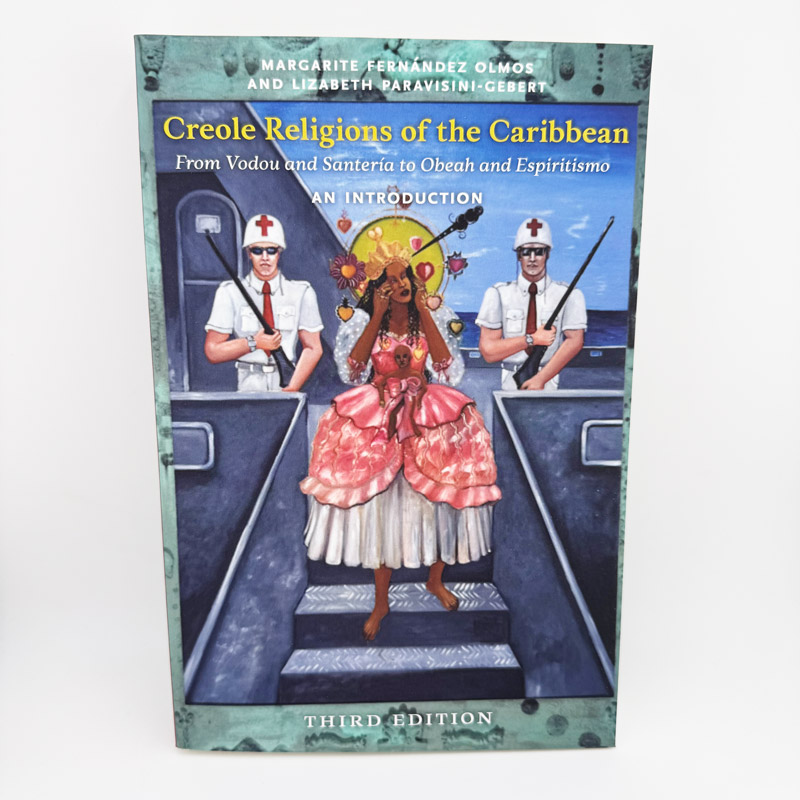
Creole Religions of the Caribbean, Third Edition: An Introduction
Creole Religions of the Caribbean, Third Edition: An Introduction explores the religious traditions that developed throughout the Caribbean as African spiritual systems, European Christianity, Indigenous practices and local forms of healing encountered one another through colonisation, enslavement, migration and cultural survival.
The word Creole here refers to this process of adaptation and creation. Caribbean religions were not simply preserved versions of African traditions, nor were they straightforward forms of Christianity imposed by European colonisers. Across different islands and communities, people retained, adapted and combined spiritual knowledge to create distinct religious systems rooted in the particular histories and cultures of the Caribbean.
This book traces those histories while introducing some of the region’s most significant spiritual and religious traditions.
Haitian Vodou developed from several West and Central African religious traditions alongside influences from Roman Catholicism and the particular history of Haiti. Its practice centres on relationships with the lwa, spirits who are approached through prayer, song, offerings, ceremony and possession, with ancestors also holding an important place within religious life.
Santería, or Regla de Ocha/Lukumí, developed primarily in Cuba from Yorùbá religious traditions carried across the Atlantic through enslavement. Its cosmology centres on the Orishas, with divination, initiation, offerings, drumming, song and relationships between practitioners and their spiritual lineages forming important parts of the tradition. Historical circumstances also produced visible relationships between Orishas and Catholic saints.
Regla de Palo, also strongly associated with Cuba, draws primarily from Central African Kongo religious traditions. Its practices centre on relationships with spiritual forces, the dead and the natural world, with ritual objects and specially prepared vessels occupying important roles within initiated practice.
The Abakuá is an Afro-Cuban initiatory society whose origins can be traced to the Ekpe societies of the Cross River region of present-day Nigeria and Cameroon. Its history demonstrates how African social and religious institutions were not only remembered in the Caribbean but reorganised and maintained within new cultural circumstances.
Obeah is found particularly throughout the English-speaking Caribbean and is better understood as a broad range of spiritual, healing and protective practices than as one centrally organised religion. Its history is closely tied to African-derived knowledge, herbal and spiritual healing, protection, divination and resistance, as well as the colonial laws that attempted to criminalise and suppress it.
Quimbois, particularly associated with Martinique and Guadeloupe, belongs to the spiritual and folk-healing landscape of the French Caribbean. It incorporates approaches to healing, protection, divination and practical spiritual work shaped by African, European and Caribbean influences.
Espiritismo, which became particularly influential in Puerto Rico and Cuba, developed from nineteenth-century Spiritualism and Spiritism but took distinctive forms within the Caribbean. Communication with spirits, mediumship and spiritual development became intertwined with existing Caribbean understandings of ancestors, healing and the spirit world.
The book also examines Rastafari, which emerged in Jamaica during the twentieth century. Rastafari developed within the political and religious realities of colonial Jamaica while looking towards Africa, and particularly Ethiopia, as a source of spiritual identity, liberation and Black consciousness. Its influence has since extended far beyond Jamaica through migration, music and global Black culture.
Taken together, these traditions reveal a Caribbean spiritual landscape that cannot be understood simply as African religion, Christianity or European occultism in isolation. Creole Religions of the Caribbean examines what happened when displaced peoples maintained spiritual relationships, adapted practices to new environments, encountered other cultures and created traditions capable of surviving radically changed circumstances.
The Third Edition expands this history into the present day, considering how Caribbean religions continue to develop through migration and diaspora, including their influence within Latinx communities in the United States. It also incorporates newer approaches to the study of religion through queer studies, environmental studies and diasporic studies.
Material culture is given greater attention too, looking beyond formal religious practice to consider the influence of Creole religions upon art, music, literature, healing practices and wider Caribbean culture.
For anyone wanting to understand Vodou, Santería, Obeah and other Caribbean traditions within the histories that actually produced them, rather than encountering each practice in isolation, Creole Religions of the Caribbean provides the wider picture: how religion, colonisation, African cultural survival, resistance, migration and creativity shaped the extraordinarily complex spiritual landscape of the Caribbean.


